Once again, we reach into our goodie bag of "old and forgotten drinks" for this week's happy hour. The Orange Blossom appears to have been a very popular drink once upon a time, but it's obscure even to us.
Why do we say that it was popular? Well, from our own anecdotal experience, we'd have no basis to say so, because it's not a drink we encounter at all, or even hear referenced. But, there's some evidence we have uncovered in our frequent expeditions to estate sales (read about them on our sister blog, estatesalestories.blogspot.com) that hint at the history of this drink.
First, we acquired this charming glass that goes with a shaker at one estate sale:

The photo may not very clearly depict the graphic, but the side of the glass features recipes for some classic drinks: a Martini, a Manhattan, a Bronx, a Daiquiri, and .... an Orange Blossom? Okay, the Bronx is a little obscure nowadays (as we have duly noted several times in prior happy hour discussions), but those other drinks are old standards. Why would an Orange Blossom be included in their company? Was the Orange Blossom a quiet favorite that everyone was gulping down 50 years ago, but never mentions anymore? Here's another piece of evidence we uncovered in an estate sale purchase:

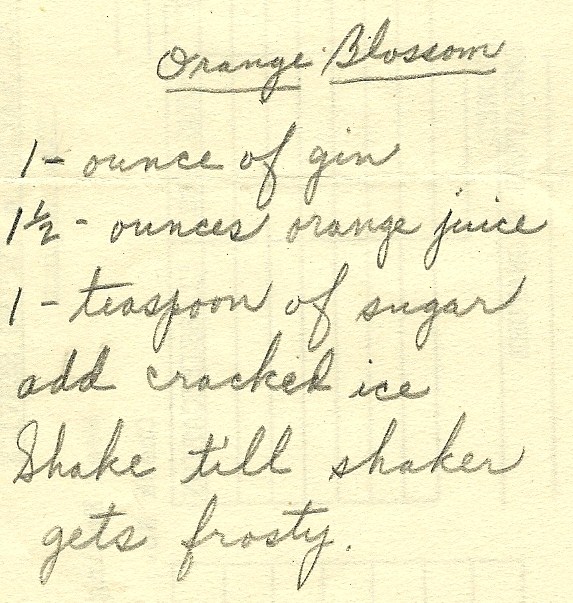
This is a handwritten recipe that was tucked into a cocktail booklet we picked up at a sale. This was written down sometime in the 1950s, which we know because it's written on the reverse side of a time sheet from someone's job where they had to fill in the date, and the year was provided as "195___". So, some archaeological clues, we suppose. The fact that this person wrote out the specific recipe seems to indicate how important this drink was to them -- and the instructions ("shake till shaker gets frosty") offer a charming glimpse into this person's bartending technique.
Here's a recipe from Oscar Haimo's "Cocktail and Wine Digest: Encyclopedia & Guide for Home & Bar" from 1946:

Another point that we need to discuss in relation to this drink is how much diversity there is in its ingredients. So far, we see that it, at minimum, takes orange juice and gin. The proportions of the gin and orange juice vary widely. Some recipes call for sugar to be added. The recipe on the side of the glass called for nutmeg. Here's a recipe from the 1964 edition of "Famous New Orleans Drinks And How to Mix 'Em":

Well, they kind of explain it there, don't they? To prove their point, here's the recipe from our 1933 edition of "The Drink Master":

Instead of Peychaud's bitters, they call for Angostura bitters, and instead of sugar (or grenadine or honey), they call for maple syrup. Yeah, just like the topping for your pancakes. Oh, and be sure you don't miss the little detail that this recipe is supposed to serve two. We don't know about you, but not in our household!
Next, we have a recipe from a 1960's era Fleischmann's booklet:

Here, they take the drink down to its basics: just a 1:1 ratio of OJ and gin.
But, wait .... now this drink is kind of sounding familiar .... like something we've heard of .... oh, a Screwdriver, except with gin instead of vodka! As we've commented on in the past, gin is a spirit that is slightly out of vogue (to put it mildly, and lamentably). So, maybe the Orange Blossom is as popular as ever, except that it changed its name and got a few nips-and-tucks and transformed itself into a Screwdriver? In the era when the Orange Blossom evidently had its heyday, vodka was not readily available -- could it be that as vodka came onto the market and became so popular the Orange Blossom just modernized and changed with the times?
Well, something to ponder. Regardless, here's to keeping up with the times! Cheers!


 Don't forget to notice the inset with the measurements, which come in handy when making these classic rum concoctions (and some that are perhaps improved with rum):
 And, for a big finish, one word: Coconga!
 Cheers!